Writings by Savarkar · Book · 1923
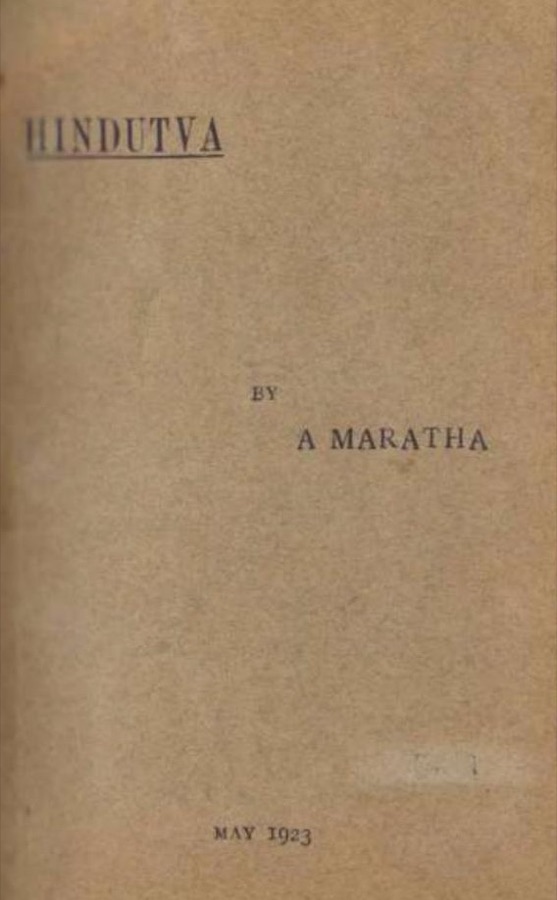
Essentials of Hindutva
Savarkar's 1923 book defining Hindutva through three bonds: a common land (rashtra), a common descent (jati) and a common culture (sanskriti), closed by the test that India be both fatherland and holy land.

- Date
- 1923
- Author
- V. D. Savarkar
- Language
- English
- Kind
- Book
Essentials of Hindutva was written while Savarkar was confined in Ratnagiri and first appeared in 1923. Later editions carry the title Hindutva: Who Is a Hindu?
The book separates Hindutva from Hinduism. It treats Hindutva as a political and civilizational identity, not a religious doctrine alone. It reaches across regions, castes, sects and schools of philosophy, and names Buddhists, Jains, Sikhs, theists and atheists inside a common inheritance.
It also draws a boundary. A Hindu, in the book's definition, is one for whom the land from the Sindhu to the seas is both fatherland and holy land. Muslims and Christians are placed outside that category where their holy lands lie outside India, even where the book acknowledges shared ancestry and culture.
One line from the text, at page 32: “The fundamental unity of man from pole to pole is true, all else only relatively so.”
Original source: Scanned edition hosted by savarkar.org (PDF)
Cite this page
Savarkar Archive. “Essentials of Hindutva (1923).” https://savarkararchive.com/documents/essentials-of-hindutva-1923. Accessed [date].
Permanent address: https://savarkararchive.com/documents/essentials-of-hindutva-1923