28 May 1883 – 26 February 1966
Vinayak Damodar Savarkar: the life and the work
He was a revolutionary at fifteen, a banned author at twenty-five and a prisoner for life, twice over, at twenty-seven. He was also a historian, a poet, a reformer of caste and the leader of a party.
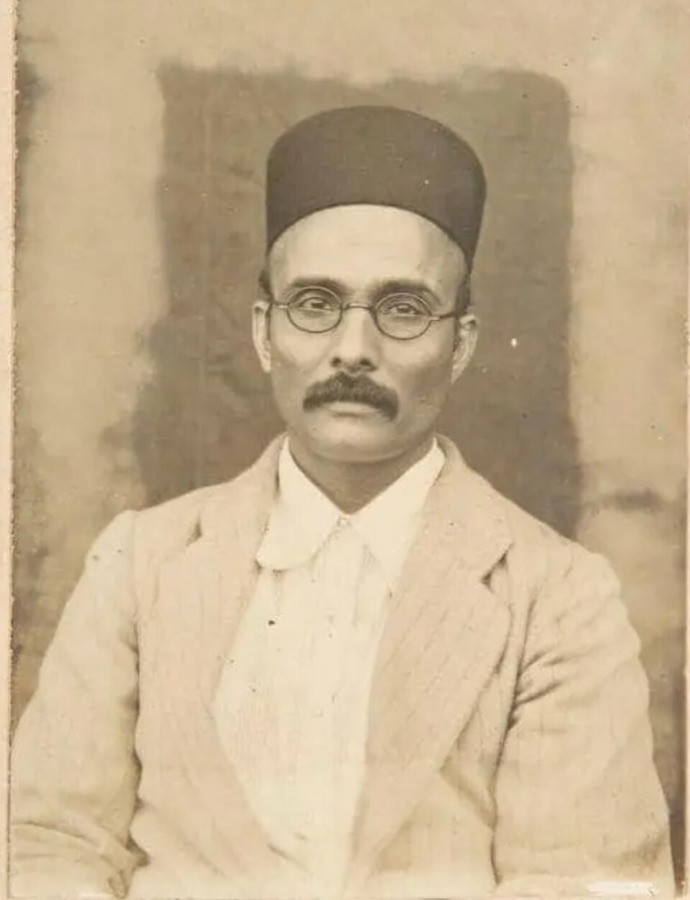

Revolutionary
At fifteen he swore to fight for India's freedom. At sixteen he founded a secret society; at twenty-one, Abhinav Bharat. In London he turned a students' hostel into the centre of the Indian revolutionary movement in Europe. When the British shipped him home for trial he went through a porthole at Marseilles and swam for France, and two empires ended up before a tribunal at The Hague over one prisoner.
Historian
At twenty-five he wrote the book that named 1857 a war of independence. The Government of India banned it before it was printed. It was printed anyway, in Holland, smuggled into India in false covers, and reissued by revolutionaries for forty years. He went on to write the history of the Marathas and, at eighty, Six Glorious Epochs of Indian History.
Prisoner
Two sentences of transportation for life, to run one after the other: fifty years, passed on a man of twenty-seven. He served ten years in the Cellular Jail at Port Blair, three more in mainland prisons and thirteen confined to one district. His letters home were limited and censored. The ones that survive are here.
Poet
He wrote some of the best-known patriotic poems in Marathi, among them Jayostute and Sagara Pran Talmalala, the second written on the shore at Brighton in 1909. In the Andamans, by his own account, he composed without pen or paper, scratching lines on the wall of his cell and holding thousands of them in memory.
Reformer
Barred from politics at Ratnagiri, he went after caste. He named seven prohibitions that bound Hindu society and set out to break each one: public inter-caste dinners from 1930, and in 1931 a temple open to every Hindu, the Patit Pavan Mandir. He argued for science over scripture and wrote that the cow was a useful animal, not a god.
Thinker and leader
In 1923, from prison, he published Essentials of Hindutva and gave Indian politics a word it has argued over ever since. From 1937 he led the Hindu Mahasabha for six years. His presidential addresses are collected in Hindu Rashtra Darshan.
Honours
- Honorary D.Litt., University of Nagpur, 1943, and University of Poona, 1959.
- President of the Marathi Sahitya Sammelan, 1938.
- Commemorative postage stamp, Government of India, 28 May 1970.
- Blue plaque at 65 Cromwell Avenue, Highgate, London, 1985.
- Port Blair airport renamed Veer Savarkar International Airport, 2002.
- Portrait unveiled in the Central Hall of Parliament by the President of India, 26 February 2003.
What is argued over
No account of Savarkar is complete without the arguments. Each has its own page here.